

Things have changed. Maybe we should have changed our strategy & our OKRs, too. Image via Midjourney.
Watching these things can prevent you from following an outdated strategy to failure
“The greatest danger in times of turbulence is not turbulence itself, but to act with yesterday’s logic.”
–Peter Drucker
The global consultancy’s massive, slick deck featured a “can’t-miss” strategy that promised “hockey-stick” growth and revenue projections.
What could go wrong?
Plenty, as it turned out.
Strategy deck in hand, we set out to craft our set of OKR goals to deliver against it, and started pursuing the strategy through the marketing and sales networks.
Cracks appear
Fortunately, our VP of Product was skeptical from day one.
One of the numbers we had discussed keeping an eye on was “Customer Acquisition Cost,” (“CAC”), always a crucial area of focus in any marketing effort. After the Key Results still didn’t budge over several quarters, they dug into the numbers, and discovered the strategy was bringing in only a fraction of the intended profit per sale.
Far from being the “guaranteed” income generator promised, we were alarmed to discover we were digging a deeper hole with every new customer.
Team collaboration
But what if we had not had a skeptical, experienced Product leader?
What if we hadn’t had the ongoing conversations that led us to uncover the truth, and pivot the team before it was too late? What if we instead were led by someone who took the global consultancy’s strategy at face value, and insisted on following it, to wherever it led?
Despite the consultancy’s fame and track record, our group would no doubt have amassed significant losses.
Still our North Star?
Is our strategy still taking us where we want to go? Is it solving the problems that most need to be solved?
How will we know if our OKRs are still taking us in the right direction? Are we even able to tell? Or have we gone off-track, reaching for goals that no longer make sense?
How can we know it’s time to adapt and re-set?
Legacy lock-in
It may seem hard to believe, but many companies still insist on a 70–80 year-old approach of setting rigid, 5-year strategic planning and budgeting cycles before revisiting their strategy and goals.
But in this Internet-enabled, AI-powered age, conditions can change in an instant, and customers can jump at will to a competitor. If we’re unable to break free of our constraints and pay attention to the right signals, we’ll miss seeing crucial warning signs that it’s time to change.
And it’s one of the most important shifts we can make.
Rowing in the right direction?
Because getting even a small group of leaders to align around shared strategy and goals is so time-consuming and complex (“Planning Season”), we run the risk they’re already obsolete by the time the teams finally start working against them.
And if we don’t pay attention to the right signals and adapt, we could literally be like lemmings, blindly following an outdated strategy over a cliff.
Learning to see the signs
Fortunately, in my strategy and OKR goal-setting coaching, I’ve identified natural built-in review mechanisms that can help us recognize whether to “pivot” or “persevere.”
Instead of being stuck in the legacy multi-year cycles of industrial business, we can respond at the speed of digital, web-enabled businesses.
Here are 3 ways to know it’s time to adapt our strategy and the OKRs that deliver against them:
- Set clear “What Would Have To Be True” conditions
- Set and watch Leading Key Results, week over week
- Pair OKRs with matched “Health Metrics”
Let’s dive into each.
Sign 1: Are our “What Would Have To Be True?” conditions still true?
First off, and perhaps most importantly — Never start with goals or plans.

Always start with a clear set of strategic choices rooted in client needs.
Remember that OKRs, as with any management system, are only a mechanism to keep us focused on delivering against our higher-level strategy.
Without a guiding set of strategic choices, we’re randomly setting goals and reduced to “hoping” or “wishing” we’ll achieve something bigger.
Testing our thinking in strategy design
A key feature of Roger L. Martin’s “Playing to Win” strategic choice structuring process is the 7-step strategy design practice.
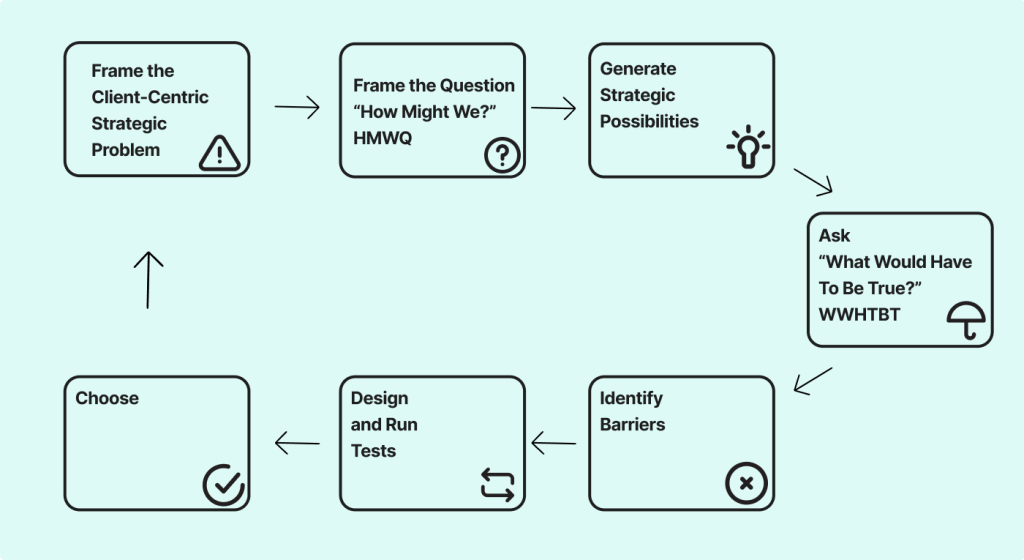
Cross-functional teams come together to design matched strategic choice sets by answering the following questions:
- Winning Aspiration — What’s our Mission or Vision?
- Where to Play — Which Customers, through which Channels, in what Geographies do we choose to serve?
- How to Win — How will we differentiate?
- Capabilities — Do we have the ability to deliver against our Where to Play and How to Win choices?
- Management Systems — How can we continuously measure and improve our capabilities?
As we collaboratively create several matched sets of strategic choice possibilities, we bring intellectual rigor to our practice by asking “the most important question in strategy,” another one of Roger Martin’s breakthroughs.
In order to test the logic underlying our matched strategic choice possibility sets, we don’t ask what we believe is true, but instead ask:
“What Would Have To Be True?”
The heart of “What Would Have To Be True?”
When we ask “What would have to be true? about:
- Our Customers — We understand how they would have to respond for them to see the value from a given set of choices and how well it delivers against their unmet needs, hopes, and desires.
- Our Company — We understand whether we have the capabilities necessary to consistently deliver against this set of choices. If not, will we need to upskill, hire, or outsource to get them?
- Our Competition — We have a sense of how our competitors might respond as we bring our strategy to market.
In this way, we can expose and continuously keep an eye on the assumptions underlying the logic that underpins our strategy.
Starting in early 2020, a small business-focused team I was coaching had chosen small, (3–4 store) family restaurant chains as their “Where to Play” customer.
As of March 2020, it was clear the only value we could provide these small, family-run chains would be to help them somehow survive the COVID-19 pandemic’s quarantine.
Keeping our “What Would Have To Be True?” front & center
Martin advises once we’ve made our set of strategic choices, we’ll want to pin their associated “What Would Have To Be True?” conditions over our desks, and keep an eye on them every day.
As soon as these conditions no longer hold true, it’s time to revisit our strategy, go back through the Strategy Choice Structuring process, and revise our choices.
Sign 2: Are Our Key Results Moving?
Once we’ve designed our strategy, and have our clear set of “What Would Have to Be True?” conditions in hand, our next step is to set our OKRs against it to measure and keep us on track towards bringing it to life.
A best practice is to have leadership set the tone by establishing the “aspirational” Objective mini-missions” to provide the teams with high-level purpose and direction for the quarter.
Teams then collaborate from the “bottom-up” to set the numeric Key Result goals which demonstrate increased confidence in achieving the Objective, and agree how to keep their OKR sets front and center throughout the cycle.
The Check-In
After several years training and coaching teams in OKRs, the single biggest determining factor of whether they’ll achieve success with the framework is their cadence of check-ins.
Anything longer than every 1–2 weeks, and the OKRs start to lose relevance to the day-to-day team activities
And with that cadence, it’s important to bring the right mindset.
Measure confidence, not progress
One fundamental shift between using OKRs as a Project Management tool versus a goal achievement and strategy realization accelerator is our approach to checking in.
Check-ins aren’t for measuring progress so much as understanding our level of confidence — how confident are we that we can achieve our Key Result, and our Objective, by the close of the OKR cycle, given our strategy and the goals we’ve set?
Is our strategy showing early promise?
Key Results Not Moving 1: Leading vs. Lagging Metrics
Of course, we won’t see anything move unless we understand the importance of setting Leading, client behavior-change outcome metrics.
Our goal is to take our client’s user journey:

And trace the connection from team-level activities, to client Opportunities to Leading user behaviors, to Lagging business Impact measurements.

We can then map these insights back onto our User Flow to see which team can do what, and the diference between Leading and Lagging metrics so we can use our strategy and find points to intervene in the ways our users interact with our systems:

By connecting the chain of logic this way, we can address user needs in ways that we can clearly ladder up to higher-level successful outcomes both for them, as well as for our business.
Too lagging to see move
Many teams moving from delivery goals to outcome-focused goals tend to go too far in the direction of lagging Business Impact outcomes.
This was the case with another team I was coaching. Their leadership refused to let the team set “activity” or milestone Key Results. They instead insisted on imposing their own business-value, dollar income and Return on Investment (“ROI”) goals as Key Results.
Worse, because there were far too few, and way overworked data people available, the team’s Key Results couldn’t be scored at any point during the quarter, so there was nothing to “check in” against.
It ultimately took as long as a month after the close of a quarter for this Program to understand how they had done against their Key Results.
A missed opportunity
While I tried to coach them to shift towards more leading goals, leadership refused to budge.
This was a huge miss, because teams can use their closeness to clients to speak with them, and see how changes to copy, creative, user screens, or flows can positively influence the desired behaviors.
The danger is if we don’t set goals teams can materially impact during the quarter that ladder up to the larger, lagging changes we seek, our teams won’t be able to know what “levers” to pull to shift that behavior.
A hidden challenge
But the biggest impact? Team morale. Because teams can’t see their numbers move in response to anything they do, they’ll be reduced to going through the motions and hoping.
An easy way to solve this? Map your own user journeys, and the flow of Outputs >> Outcomes >> Opportunities >> Business Impact.
Only in this way can they take ownership and see what levers they can pull to influence client behaviors and set leading Client Outcome Behavior Change Key Results accordingly.

Key Results Not Moving 2: Retrospecting for Continuous Improvement
While leading client behavior change Key Results metrics are always an OKR best practice, it may take teams multiple check-ins over several cycles to develop this awareness.
Remember, it’s never about perfection. It’s about continuously making progress. I’ve seen teams start by setting the most basic, task-based goals as Key Results. But through a series of quick, lightweight retrospectives over every check-in, they’ve developed an extremely evolved OKR practice.
We have the opportunity to develop a truly great strategy to delivery flow of value across our people and teams, using OKRs as our management system for focus and achievement.
The power of the conversation
Having regular, quality conversations, and taking advantage of top-down, bottom-up collaboration is essential to pivoting at the right time.
As Christina Wodtke says, the real value of any OKR-focused meeting, from the check-in to the quarterly reflect and reset cycle, are the conversations that result from reviewing the numbers together.
Sign 3: Are we protecting our “Health Metrics”?
One of my favorite approaches I’ve had success with coaching teams with OKRs is Christina Wodtke’s “Four Square,” which I’ve written about here, and created Miro and FigJam templates for.

One thing the Four Square does extremely well is balance our forward-thinking aspirational OKR with our Health Metrics. Because just as important as the goals we strive for are the things we need to protect.
Skillfully matching aspirational Key Results metrics with the appropriate Health Metrics will make all the difference between achieving a single goal, and building a devoted user base and sustaining a culture of delivery excellence over the longer-term.
Areas to Protect
The following “Health Metrics,” or “Key Performance Indicators” (“KPIs”) make sense for any team to track.
Every OKR “check-in” with the Four Square becomes an opportunity to review the health of each of these with a simple “red, yellow, green” status rating:
- Team Health
- Client Satisfaction
- Code Health
- Customer Acquisition Cost
- Profit
Again — it’s not the number, or the color — it’s the conversations these kinds of reviews facilitate, and the shifts that get made as a result.

If you’re new to the concept of Health Metrics, and are committed to building and sustaining high-performing teams, I highly recommend you internalize Headspace’s Chief Product Officer’s Leslie Witt’s essential “air, water, and food mental model.”
TL;dr: & Takeaways
While our strategy and its matched OKR goals can lead us to our greatest achievements, they can just as easily lead us in the wrong direction if we aren’t able to recognize and respond when conditions have changed.
Set them collaboratively and thoughtfully, and follow them, but always with a healthy dose of curiosity and skepticism.
Thanks to these three simple approaches:
- Set clear “What Would Have To Be True” conditions
- Watch Key Results, week over week
- Pair OKRs with matched “Health Metrics”
We have a range of choices for sensing and addressing when we might need to review both our strategy, and our OKRs, and adjust course along the way.
Remember — while revisiting our strategy collaboratively may seem like hard work, we need to resist the temptation and inertia to keep executing in the “hope” things might work out OK.
As Peter Drucker reminds us, approaching today’s problems with yesterday’s thinking will always be our greatest danger.
You must be logged in to post a comment.